Thermal Drone inspection Nuevasol Oct 8, 2026

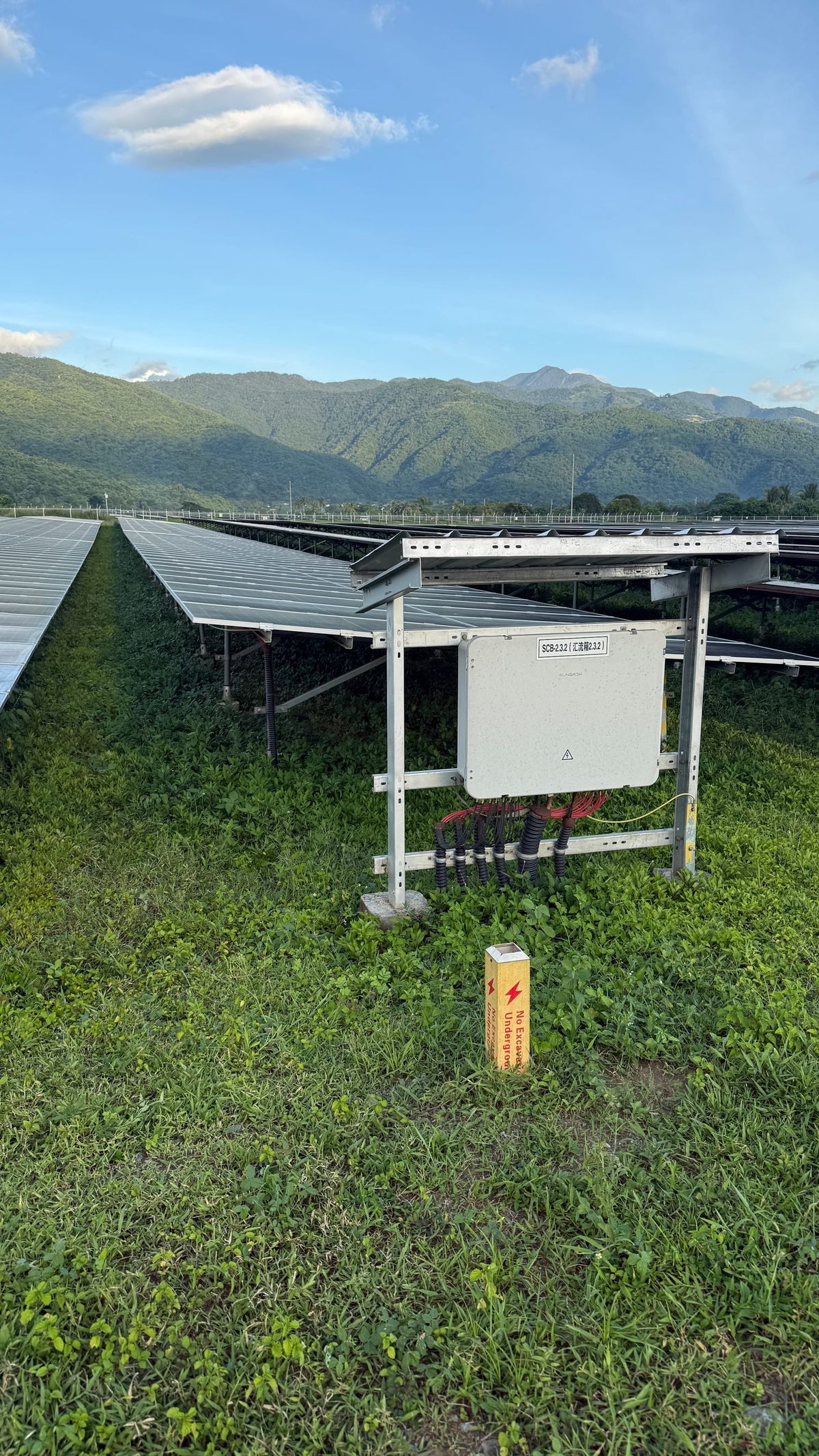
We made another visit to the Nuevasol Solar Farm, a 42MWDC/ 33MWAC system covering 40 hectares.
It felt like this time the feeling of the inspection was different.
This time we had the chance to spend time inside the control room and dive deeper in the workings of the plant.
I sat down with the engineers/ technicians of the plant to discuss mainly on why the plant is underperforming. I have learned that there is a difference between what is perceived as underperforming and the actual production. This is where I learned about the raw production numbers and the Performance Ratio. In my pre visit studies I read about module degradation, failure mechanism of newly manufactured modules called TopCon (Tunnel Oxide Contact modules). I also read about NREL standards on how to properly conduct O&M services. To take care of the plant is not only physically tending to the equipment but also making the right analysis and setting proper benchmarks. PR calculations had a chapter of its own and now I know the reason.
In this plant Sungrow is the O&M provider and Hexa is the owners of the plant. In short, when I sat down with the engineers, the first paradox (at least to me) was presented to me. The plant is seemingly producing what it should produce but the PR is sitting in the higher or mid 70s, 76% at its lowest. The contractual agreement is to have PR hover around 84%, for that month.
I reviewed the formula they use for how to calculate PR and it was different from what I read in the NREL standard. The main difference I would say is that the NREL formula does not account for field conditions, like irradiance or temperature. It only calculates actual production over expected output.
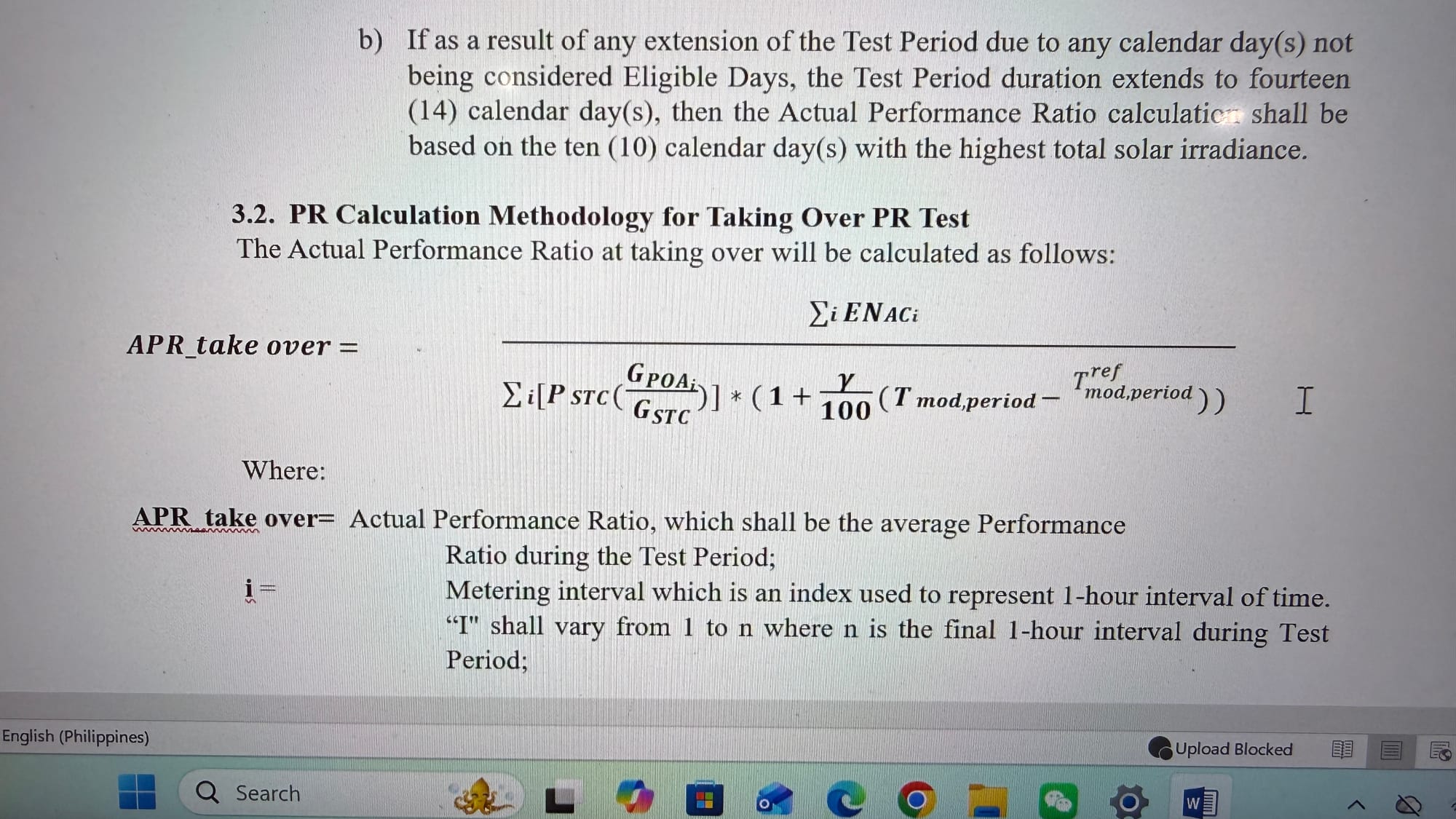
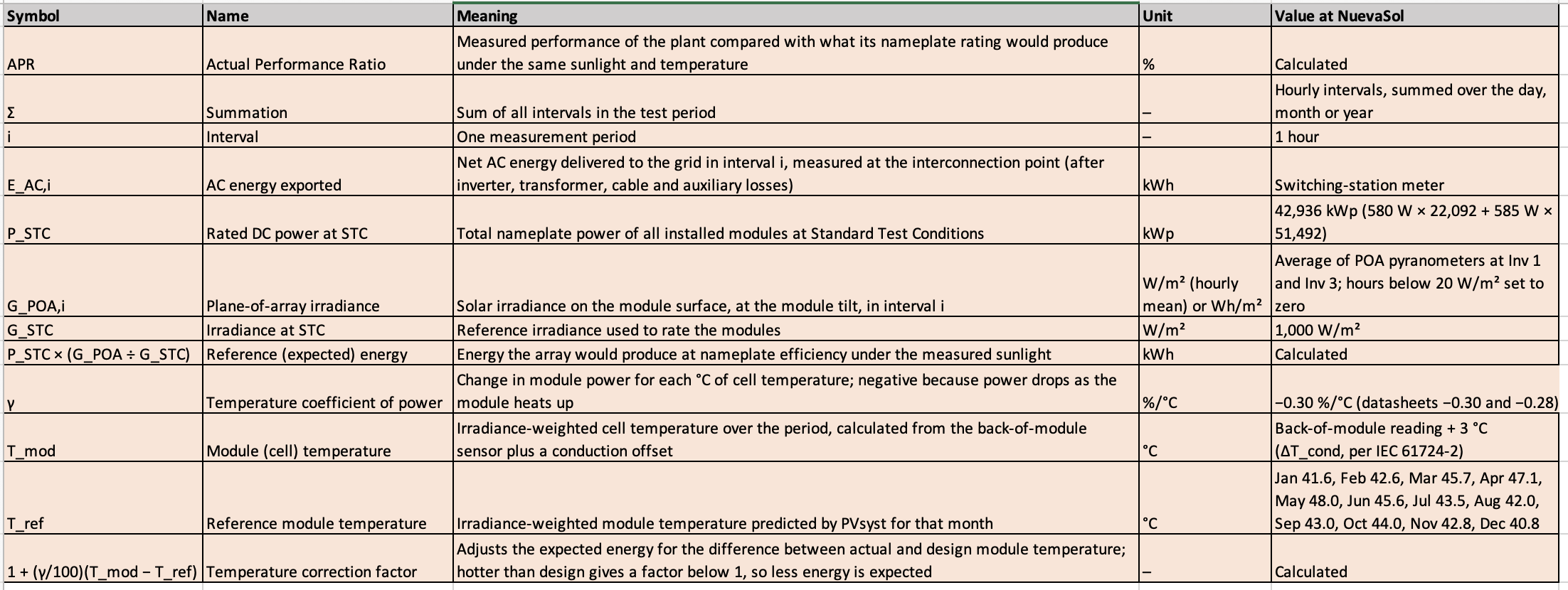
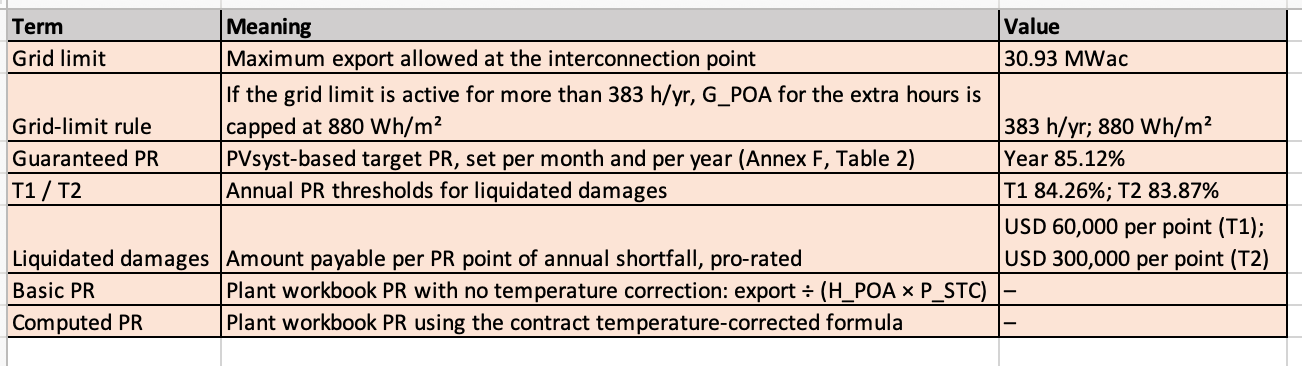
This is where I learned that the numbers are subject to being skewed based on a number of things. One of which is irradiance and temperature readings. You can see the formulas for Basic PR (NREL) and the formula used at the plant (Computed PR).
It was also confirmed that since the energization of the plant, the weather station had not been calibrated. The following are the effects of how irradiance and temperature affects the outcome of PR:
IRRADIANCE
Sensor reads low
Possible causes: old, drifted, dirty, dome, or wet or failed desiccant.
What happens: plants reads that irradiance came in lower than reality. Plants looks like it did well with little sun, so PR comes out too high.
Sensor reads high
Possible causes: uncalibrated
What happens: the plant looks like it wasted sunlight, so PR comes out too low.
Consequences of both
A 3% irradiance error gives about a 3% PR error, roughly 2.5 PR points at an 80% PR.
Consequence for soiling
If the sensor is cleaner than the modules, PR shows the full soiling loss. If the sensor is as dirty as the modules, soiling hides from the PR. If the sensor is dirty, and the modules are clean, then PR comes out too high.
Failed desiccant
Desiccant is the drying agent inside the pyrometer, acts just like sachet inside of your shoe box that absorbs any moisture that leaks in. Apparently you can see a color change marker to determine if it needs to be calibrated or not. If the agent gets too saturated, there is a possibility that your glass gets foggy and the sensor corrodes.
Thermopile sensors
I am not certain if this is for all brands but there is a matte black disk behind the glass and underneath it are tiny sensing elements called thermopiles--basically sensors that acts like a transducer.
Here is a list of all causes for a weather station to lose calibration:
1UV and heat on the black disk over the thermopiles
2Glass dome ageing
3Moisture
4Soiling
5Daily heating and cooling
6Electronics drift
7Mounting shifts
TEMPERATURE
Sensor reads lower temperature
Possible causes: temperature sensor placed near the edge or frame, on a bracket, a row-end module cooled by wind, or loose with an air gap.
What happens: the formula thinks the modules were cool and should have made more power. The plant looks underperforming, and PR comes out too low.
Sensor reads hotter than real cells
Possible causes: sensor under a hot cell, near a junction box, or under a module with a fault. PR comes out too high.
Consequences of both
A 0.25-0.3PR points per 1 °C of error.
Correct spot of sensor (IEC 61724-1)
Center of a center cell on a representative module, bonded flat with thermal adhesive.
Power Loss due to incorrect temp reading
You can actually calculate power loss by each 1°C that is not accurately recorded, if your sensor is closer to the edge of the module and not the center.
Power lost= rated power x0.30% per °C
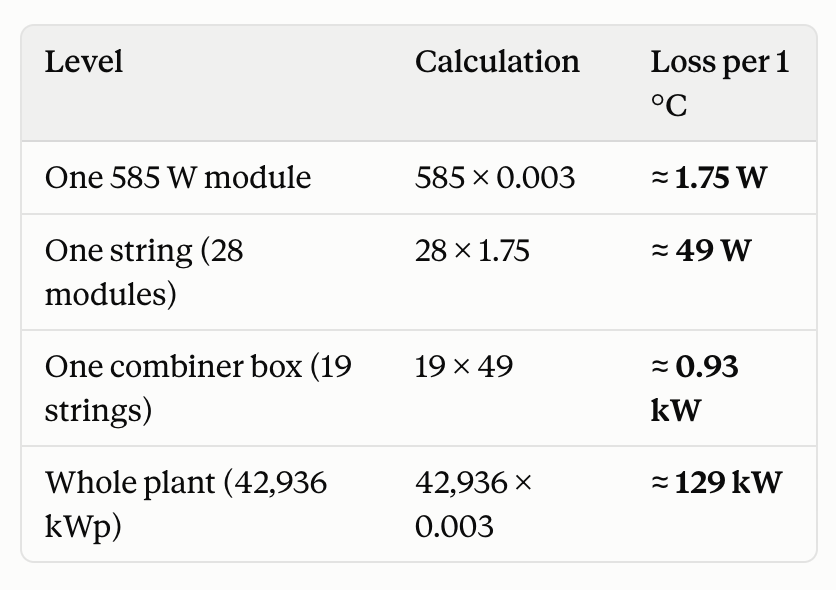
So if your temperature sensor is not at the right spot on the module and is measuring 53°C instead of 57°C, that means 516kW of production was not accounted towards the PR.